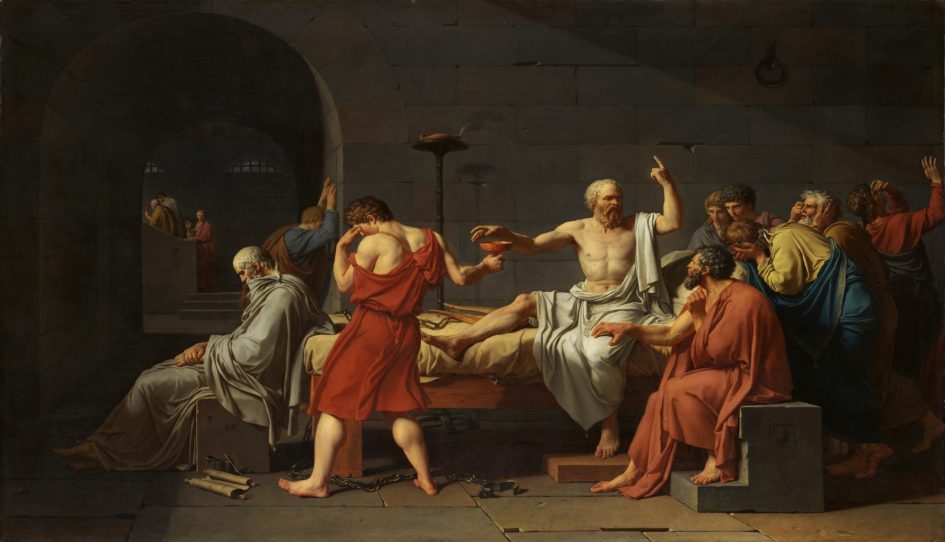
Ancient Greece was one of those epic fundamental places on Earth that fathered pretty much every new theory or idea that had to deal with the whys and what-ifs of our world. Looked like Ancient Greeks sure wondered a lot and that very wonder became an entire world-view or a universe of ideas of its own.
There are however three figures that stand taller (metaphorically speaking of course) than the rest in the realm of thinking and this post is for them – Socrates, Plato, and Aristotle. I would like to mention that I am not dismissing or diminishing the Pre-Socratic Philosophers lightly – in fact they paved the way for philosophy in general and gave us a lot of food for thought so to speak. Some of it is still hard to digest since it is for the very advanced thinkers.
Why do I say that you might ask? Because the first philosophers asked fundamental questions for any philosophy – about the origin of being and of nature. To ask oneself about the origin constitutes the first philosophical question. In fact, it is the most immediate, the most urgent thing to solve: where do I come from and why? Then we continue with some more questions like – how was the world created? Is there any will or meaning behind what happens? Is there life after death? How should we live? And so on and so on. See … like I said. Some advanced thinking.
I am fully aware that I am BARELY going to SCRATCH the surface with this post. Don’t I know it.
Their wisdom cannot be contained in mere bulletpoints but here I am. Trying to simplify things as much as possible with the hope I make you, dear reader, THINK and ASK questions…..
In the end, isn’t that everything?
Mila said this
Now let’s summarize the most important ideas from our lead characters.
The chain goes like this –> Socrates was the teacher of Plato and Plato was the teacher of Aristotle.
Therefore 1. Socrates 2. Plato 3. Aristotle
S+P+A = the best from the east to the west.
Socrates
- All our knowledge of Socrates and his methods comes to us through the writings of Plato, one of his students;
- Socrates himself wrote nothing (yeah you read that one right)
- Did not use the “spoon-feeding” method, but “dialogue – questions and answers” (later would be known as the Socratic method)
- Had to accept the limitations of our knowledge: ‘The only thing I can be certain of is I know nothing.’ Ain’t that right, huh?
- He was known as a ‘gadfly’ (an insect that can cause irritation to a huge horse); Asking the right questions to the wrong crowd will do that to you…
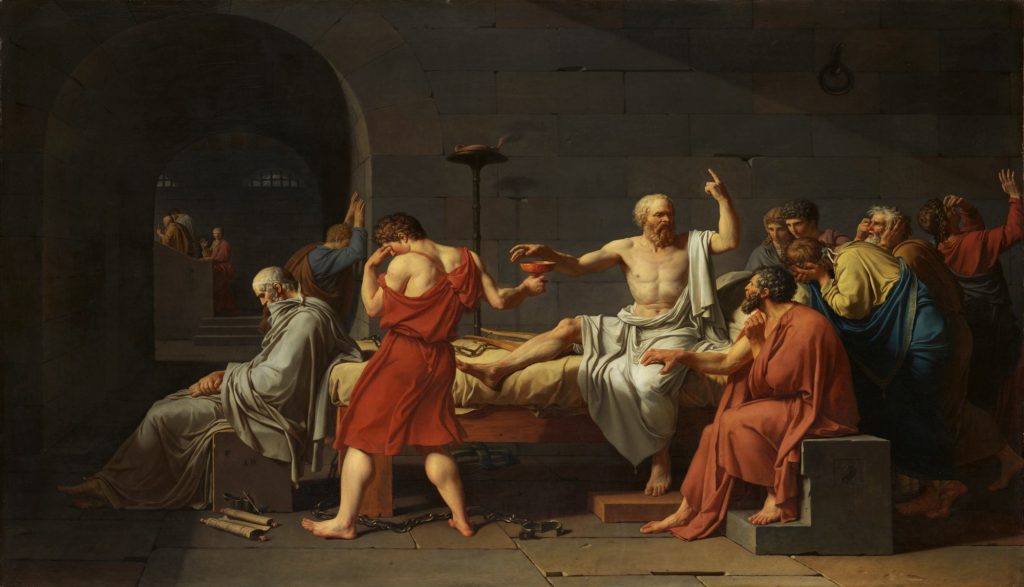
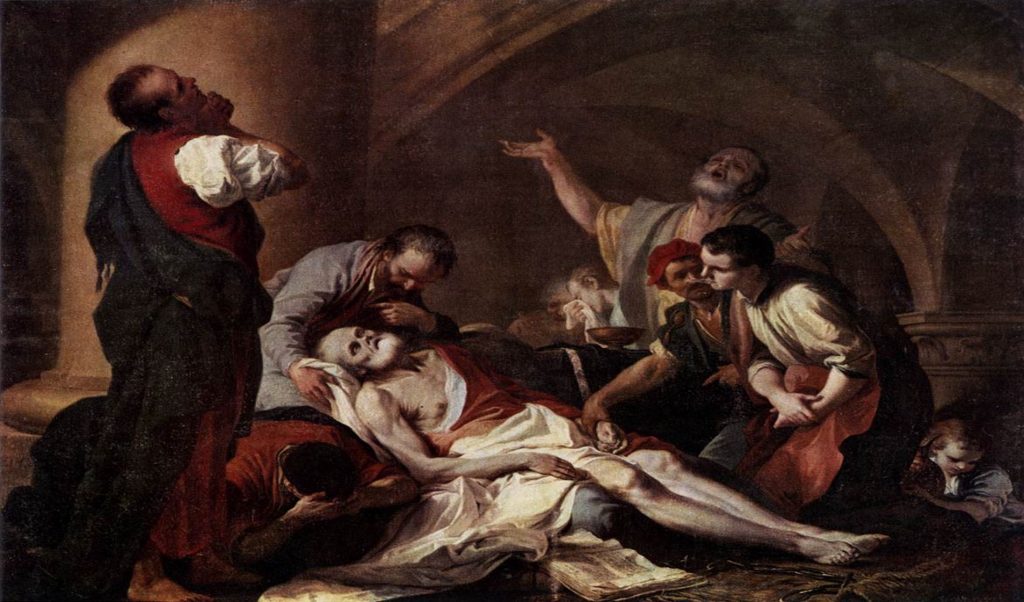
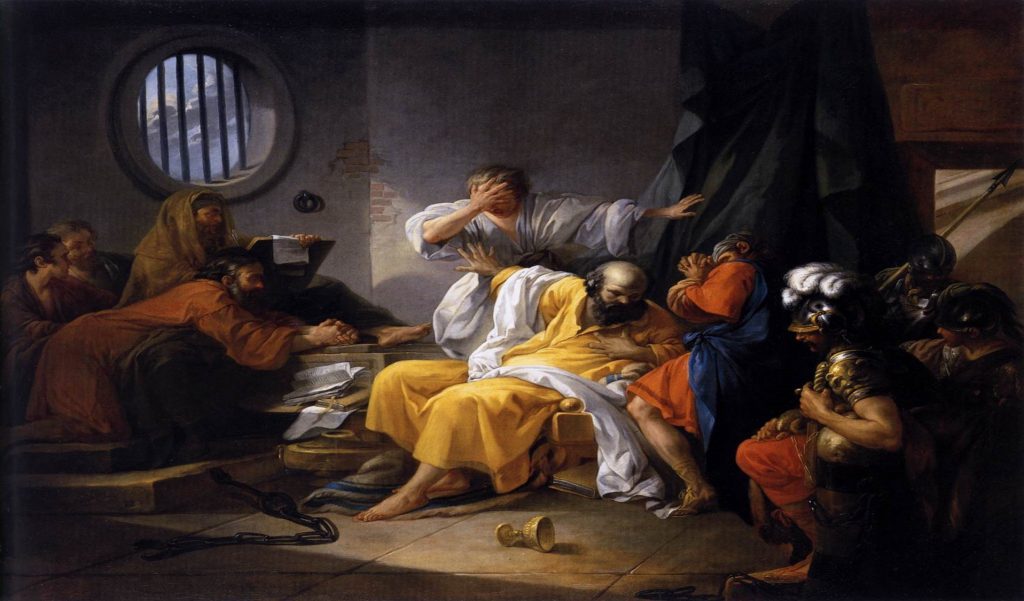
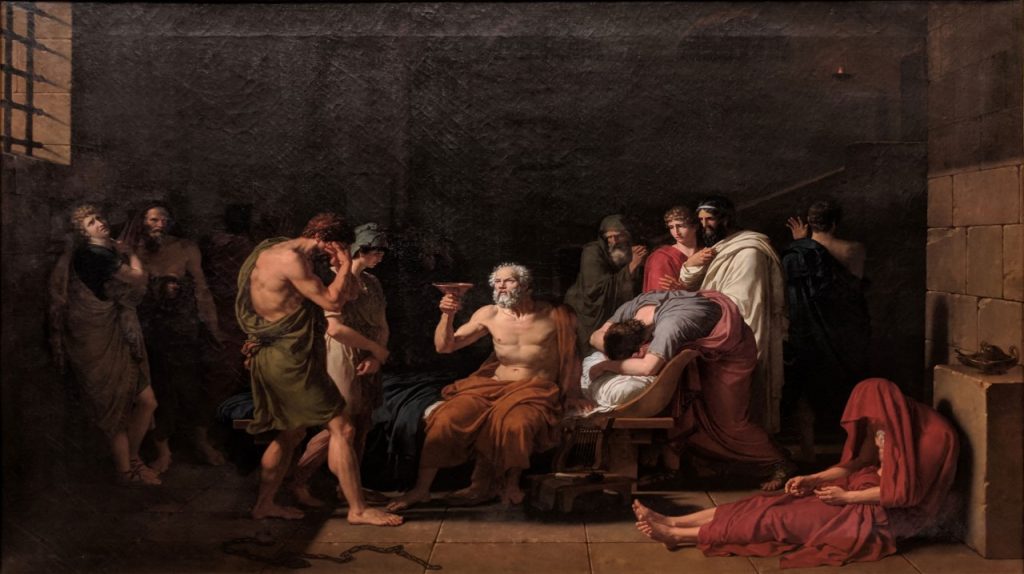
- Eventually, put to death. Now that deserves your full attention. At age 70, he was brought to trial by a jury of his fellow citizens on a charge of impiety (godlessness, sinfulness) and sentenced to death by poisoning;
- The poison is known to be hemlock. There’s NO antidote for hemlock poisoning. It can cause severe symptoms within 15 minutes of ingestion.

Fact: His death became a center theme for many art pieces throughout the centuries
Plato
- Plato was profoundly affected by both the life and the death of Socrates.
- Plato is considered the greatest philosopher of all time. “All other philosophy is a footnote to Plato”.
- The first person to develop the concept of an atom, the idea that matter is composed of some indivisible component at the smallest scale;
- For him, philosophy is not a knowledge you can transfer (“not like water that you can pour from one vessel to another”); It is more like a seed that needs time to grow! (it needs the right soil/environment and change)
- Philosophy for him was a way of living -> not facts and proof BUT values and transformation;
- Plato argued that truth had to be unchanging.
- He concluded that observation of the natural world could not be the route to obtaining truth because it was in a constant state of change.
- Mistrusted the physical world. Why? Because a constantly changing world cannot contain unchanging truths!
- Plato’s Theory of the Forms is for the advanced and “out-of-the-box-thinkers” but in short – ideal concepts of things that exist in reality e.g. justice, beauty, goodness
Aristotle
- Admired Plato but disagreed with his Theory of Forms.
- Was part of Plato’s Academy for 20 years.
- Felt that our world was the only world and therefore the only source of truth.
- Empiricist (a person who supports the theory that all knowledge is based on experience derived from the senses) so he believed we can gain knowledge through observation of the real world.
- Aristotle thought that ideas can have no real existence just on their own. They have to relate to something here in the physical world of our own experience.
- Aristotle believed that the universe was eternal, it had always existed.
- He believed the cause of change in the universe was the Prime Mover. Or the “unmoved mover” – it moves other things but is not itself moved by any prior action.
- Aristotle’s “first philosophy”, or Metaphysics, develops his theology of the Prime Mover, as πρῶτον κινοῦν ἀκίνητον – “independent divine eternal unchanging immaterial substance”…One post and a few minutes of your time will not be enough to explain that idea. You are on your own here – off the deep end.
- Aristotle never talked about God in personal or anthropomorphic terms.
- He believed the stories told about the traditional gods are absurd;
- Aristotle thought that Greek “religion” was a scam … and yet, he insisted that an ideal polis would necessarily have a minister of religious affairs… Why did Aristotle think that this was necessary or even desirable? Huge discussions have been going on for years on that topic. I dare say he was a practical man and understood that all traditional religious practices can be useful! Like instilling obedience to the law for fear of divine retribution for example. Clever, clever man.
- The Four Causes was Aristotle’s system for how we can know about things.
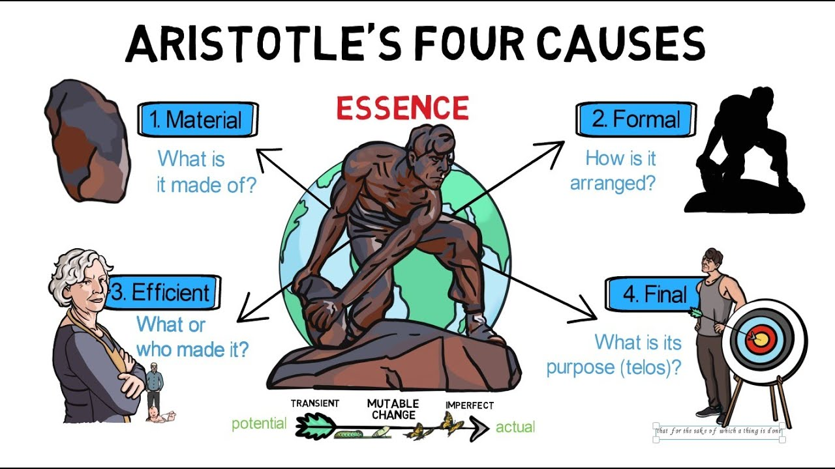
- The Final cause is the last and most important one – it formed the basis of Aristotle’s understanding of ‘Good’!
- Things can be judged to be good or bad against their ability to fulfill their potential. Your singing is off-tune = you are a bad bad singer.
Happiness is a confusing, fleeting thing…
- For Aristotle, happiness was a matter of realizing human potential.
- When we do the right thing, we are following higher, distinctively human parts of ourselves, like reason, character, and virtue.
- When we act out of self-interest, we follow the lower parts of ourselves that we have in common with other living things: pride, anger, desire, and simple hunger.
- According to Aristotle, someone who is purely self-interested can never be happy; only through virtuous action can we be happy.
Now let’s dwell on the present, not the past for a change….
Was there a time recently when you went out of your way to do something nice for someone else? What did you do?
What about a time when you put your own interests ahead of others—was it worth it?
Recent Comments